



One-Setup 5-Sided Machining: The Secret to Reducing Setup Time by 80%
In modern manufacturing facilities, equipment utilization rate is the primary driver of profitability. Surprisingly, the most significant bottleneck is often not the actual cutting time, but the inefficiency of repetitive workpiece setups. Every time a part is unclamped, flipped, and re-aligned, you are not just wasting labor hours; you are compounding the risk of machining errors.
For complex components requiring 5-sided machining, transitioning to a One-Setup strategy is more than just a time-saving measure—it is a critical investment in precision, cost control, and competitive edge.
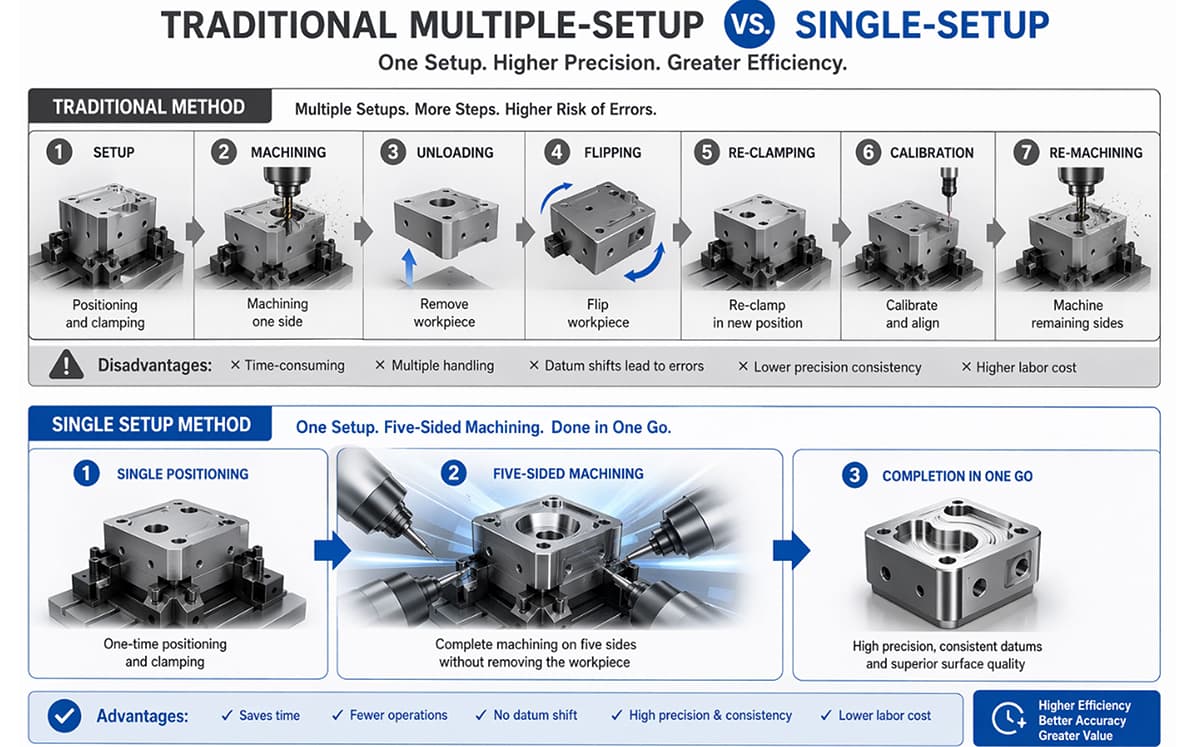
Traditional Multi-Setup vs. One-Setup Machining
In conventional workflows, a workpiece is processed on one side, then removed, re-clamped, and re-calibrated for the next operation. This process is prone to datum shift, the slight, cumulative deviation that occurs each time you establish a new reference point.
By contrast, one-setup 5-sided machining maintains a consistent reference point throughout the entire cycle. By minimizing manual intervention and repeated positioning, manufacturers can achieve significantly higher stability and tighter tolerances.
Three Strategic Benefits of One-Setup Machining
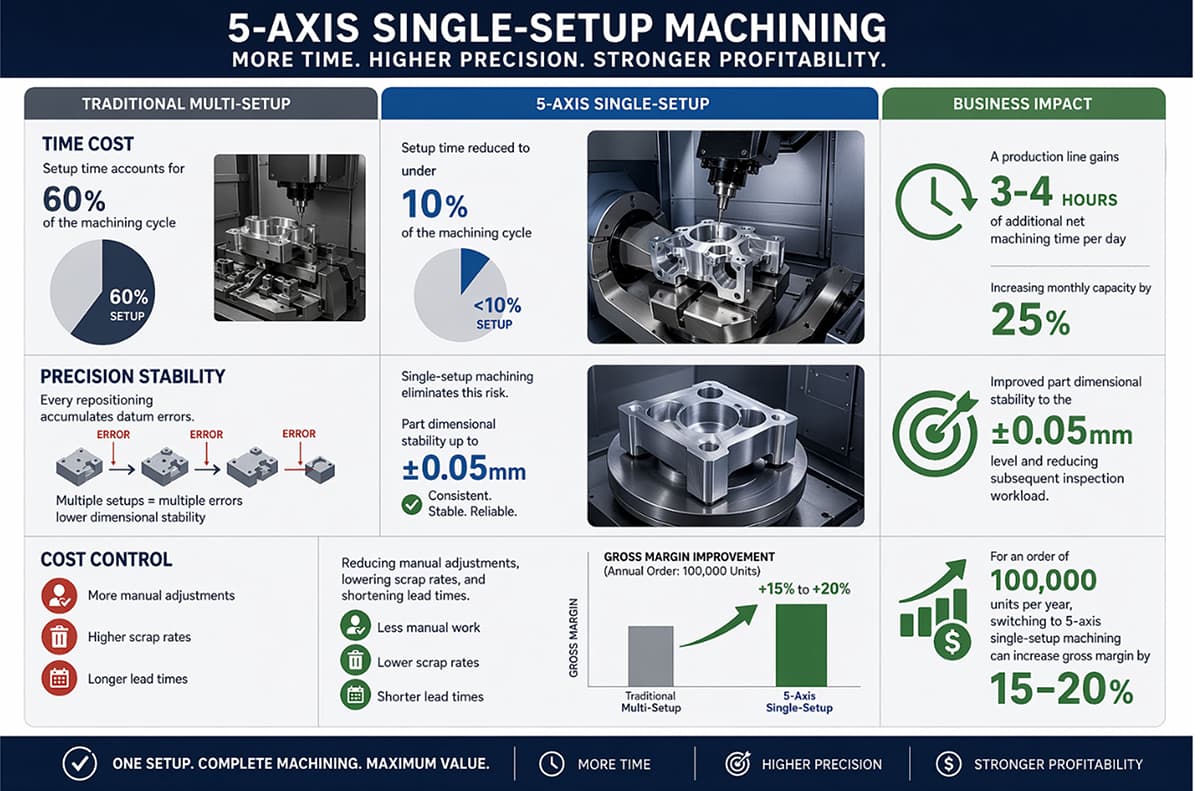
- Massive Efficiency Gains: Setup time often consumes up to 60% of the total machining cycle. By adopting a one-setup approach, this can be reduced to less than 10%. This reclaiming of production time can add 3 to 4 hours of net machining time per machine daily, potentially boosting monthly output by 25%.
- Superior Precision and Stability: Cumulative datum error is the enemy of precision. One-setup machining eliminates the risks associated with repeated repositioning, ensuring dimensional consistency across all five faces. This stability reduces the need for downstream inspection and rework, saving both time and resources.
- Lower Manufacturing Costs: Improved process stability leads to higher first-pass yields and shorter lead times. For example, in high-volume production (e.g., 100,000 units per year), switching to a 5-axis one-setup mode can improve gross margins by 15% to 20%.
Planning Your Clamping Strategy: A Systematic Approach
To successfully implement a one-setup process, consider these four pillars:
- Geometric Analysis: Identify if your part geometry is suitable. Regular shapes like blocks and cylinders are ideal; complex concave surfaces may require advanced tooling.
- Strategic Datum Selection: Select the most stable, non-deformable face as your primary reference. This decision sets the precision ceiling for your entire production run.
- CAM Interference Checks: Always use simulation to verify that the tool, holder, and spindle will not collide with the chuck or fixture during complex 5-axis movements.
- Coolant and Chip Management: Longer cycle times require proactive chip evacuation. Optimized feed rates and spindle speeds prevent chip build-up from damaging unmachined surfaces.
Five Common Clamping Methods: Selection Guide
Choosing the right clamping method is the key to a successful one-setup process. Below are the five most common options and where they fit best:
- Precision Vise: Ideal for rectangular or regular block-shaped components. Delivers good locating accuracy and clamping efficiency—the most prevalent baseline solution for five-axis applications.
- Zero-Point Clamping System: Employs standardized locating pins and modular coupling interfaces for rapid fixture and workpiece changeovers while maintaining exceptional repeat positioning accuracy. Perfect for low-volume-high-mix and automated production environments.
- Dedicated Custom Fixtures: Engineered for geometrically complex or high-volume production runs. Higher upfront tooling investment yields maximum workspace utilization, superior clamping efficiency, and unmatched consistency—essential for high-throughput, tightly-toleranced operations.
- Automatic Pallet Changer (APC) Systems: Integrates robotic handling with exchangeable work platforms to enable lights-out, 24-hour unattended machining cycles—meeting modern continuous production demands.
- Center-Hole Positioning: Common for discs and gears, this method uses the workpiece center bore for precise location and retention, ensuring rotational symmetry and axial concentricity.
Precision Clamping: The Shield Against Scrap
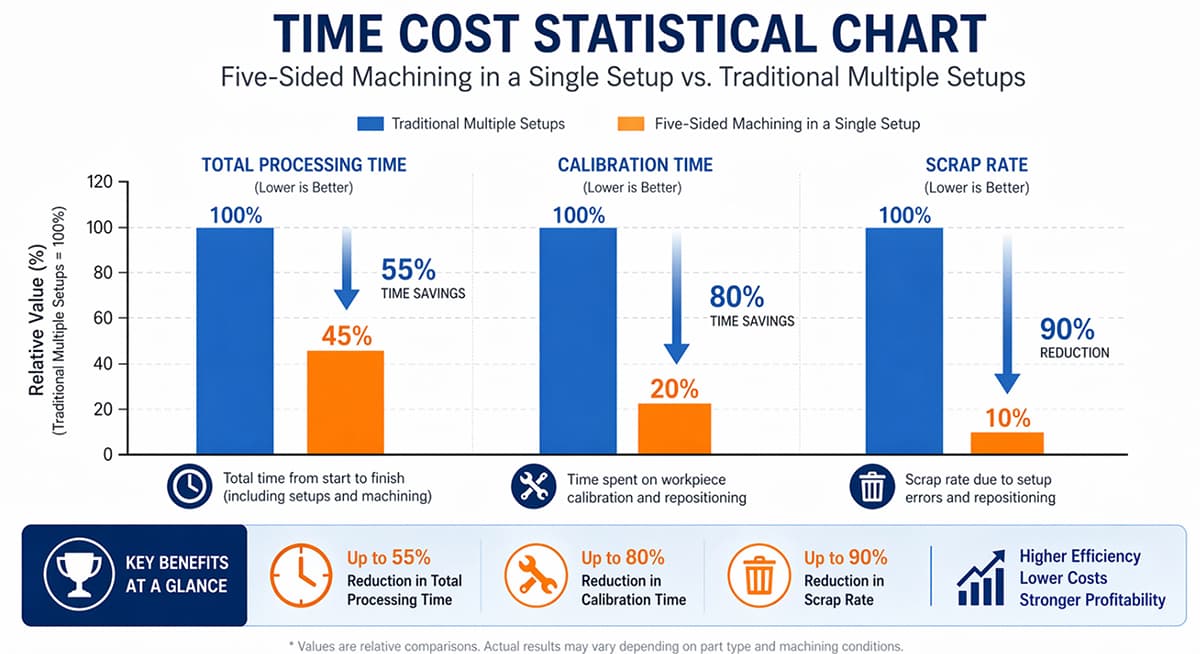
Many defects, such as hole misalignment, flatness issues, or concentricity errors, are frequently misdiagnosed as cutting tool problems, when they are actually rooted in clamping instability. In high-stakes industries like aerospace and medical device manufacturing, clamping precision is your first line of defense. By reducing secondary corrections, you streamline your entire production flow.
Ready to Optimize Your Workflow
detron's GFA and RCF series 5-axis rotary tables are specifically engineered for one-setup, 5-sided machining. With high rigidity and micron-level indexing accuracy, these solutions are designed to help you maximize efficiency and production yield.