



How to Choose the Right Rotary Table: A Complete Selection Guide
Purchasing a rotary table may seem like a straightforward procurement decision. In practice, however, many manufacturers discover too late that the selected model does not meet their production requirements. The result may be lower-than-expected machining efficiency, insufficient accuracy for customer specifications, or costly retrofits and upgrades.
Choosing the right rotary table is not simply about finding equipment that works. It is about selecting a solution that aligns with your workpieces, machining tolerances, production targets, CNC system, and long-term automation plans.
This practical rotary table selection guide outlines the key considerations that help manufacturers choose the most suitable CNC rotary table for their machining applications.
Five Key Factors for Evaluating a Rotary Table
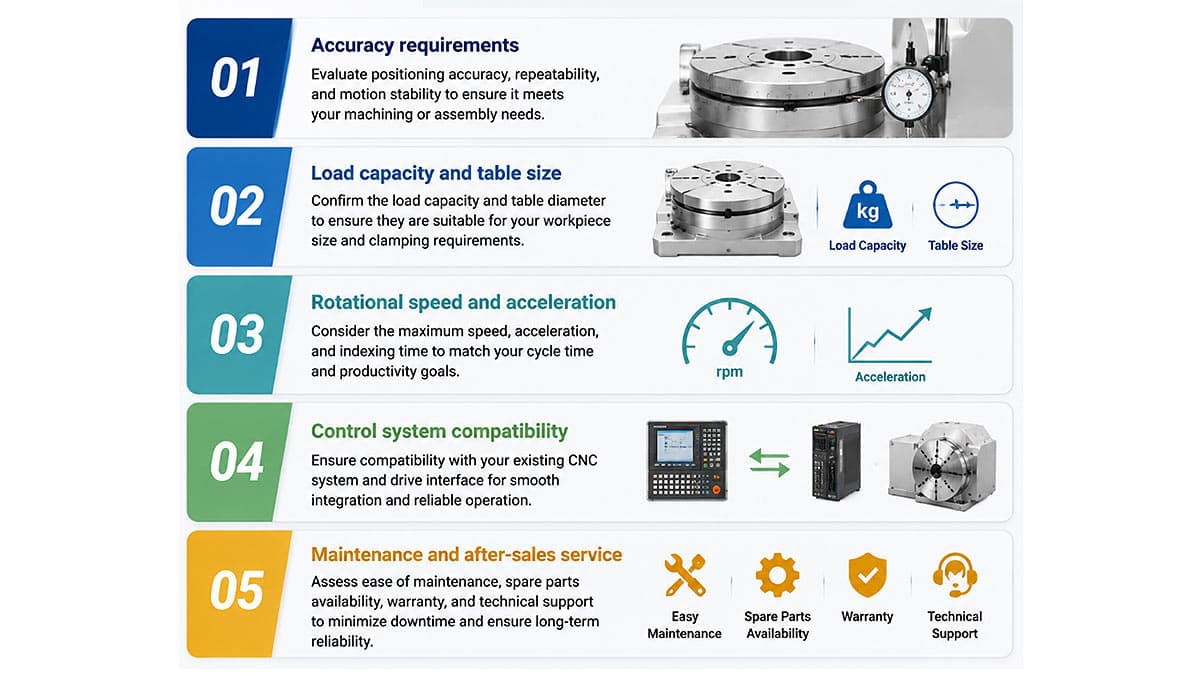
Before selecting a rotary table, we highly recommend evaluating your needs across these five critical dimensions:
- Precision Requirements
Determine the positioning accuracy and repeatability you truly need. For general machining, ±10 arc seconds is usually sufficient; for aerospace or medical components, under ±5 arc seconds is highly recommended. Because higher precision drastically increases costs, it is vital to verify your actual part tolerances first. - Load Capacity and Table Size
Factor in the total weight of the workpiece, the fixtures, and the cutting forces. A table that is too small limits your fixturing options later, while insufficient load capacity will degrade long-term accuracy and stability under heavy cuts. - Speed and Acceleration
High-efficiency machining requires rapid indexing and rotation speeds. If your production model focuses on High-Mix, Low-Volume (HMLV) manufacturing, prioritize models with high acceleration to minimize non-cutting time. - Control System Compatibility
Ensure seamless integration with your existing CNC controllers (e.g., FANUC, Mitsubishi, Heidenhain, Siemens) and verify if the system supports real-time closed-loop feedback for error compensation. - Maintenance and After-Sales Support
Warranty periods, spare parts availability, and the manufacturer's technical support capabilities are often far more crucial in the long run than the initial sticker price.
(AI-generated image)
Matching Rotary Tables to Workpiece Characteristics
Different workpieces require different rotary table configurations.
- Small, High-Precision Parts: Prioritize high-accuracy, high-rigidity models.
- Medium to Large Workpieces: Focus on heavy load capacity and highly stable structural support.
- Multi-Face Machining Parts: Ideal for standard indexing tables or full 5-axis rotary tables.
- Automated Production Lines: Consider integrating zero-point clamping systems or modular automation setups. ong/Shaft-Type Parts: A "4th-axis rotary table + tailstock" configuration is highly recommended to eliminate deflection and rigidity issues during long-part machining.
- Discs and Gears: Emphasize high RPM capabilities and exceptional indexing accuracy.
Finding the Sweet Spot: Precision vs. Cost
Many buyers initially aim for the absolute highest precision specifications available, ignoring their actual application frequency. In reality, stepping up a precision grade can increase the price by 20–40%. We recommend evaluating the most critical tolerance of your parts first. If most of your parts only require ±8 arc seconds, a ±5-second model will comfortably meet your needs at a much more reasonable cost.
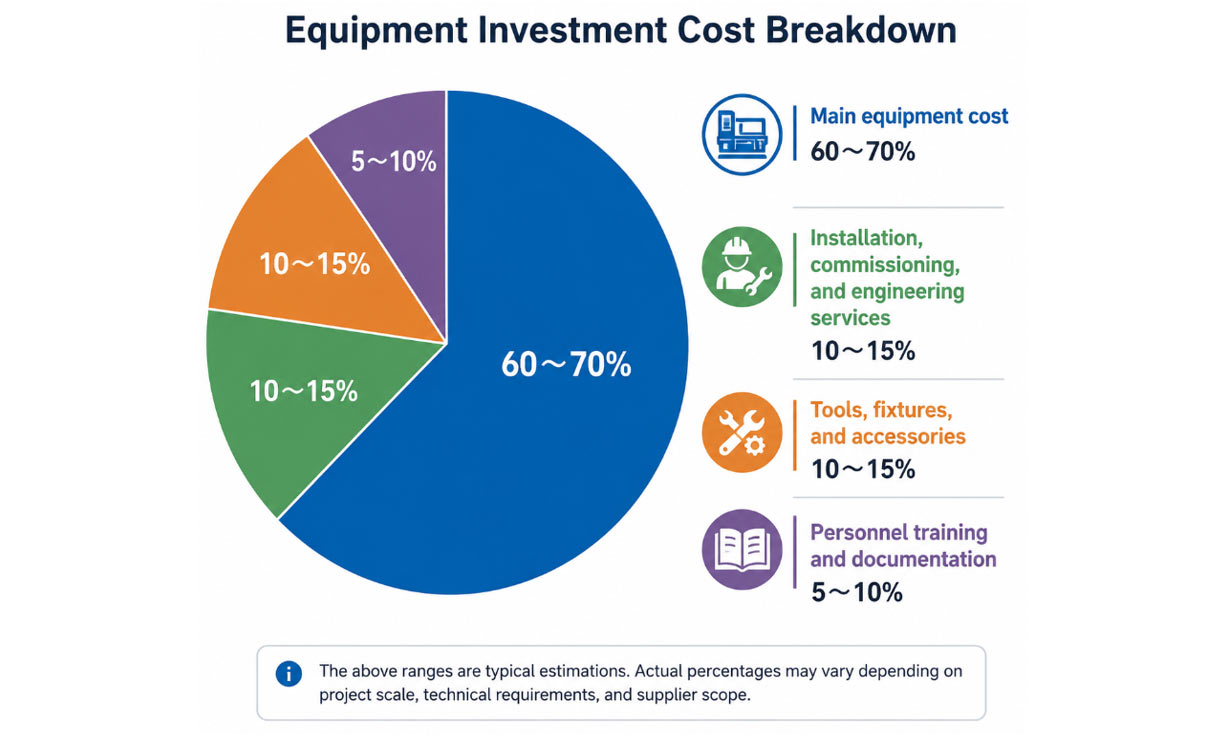
Beyond the equipment price, you must factor the following into your Total Cost of Ownership (TCO):
- Fixtures and zero-point clamping systems
- Installation, integration, and commissioning fees
- Operator training costs
- Estimated maintenance and spare parts expenses for the next three years
Budgeting Rule of Thumb: A standard budget allocation is 65–70% for the rotary table itself, 20–25% for fixtures and auxiliary equipment, with the remainder reserved for installation and spare parts.
(AI-generated image)
Common Purchasing Pitfalls to Avoid
- Pitfall 1: Focusing Solely on Price. Cheap equipment isn't always cost-effective. Unstable precision and frequent machine downtime lead to a significantly higher total cost over time.
- Pitfall 2: Ignoring Workpiece Dimensions. A mismatch between the table specs and the workpiece directly restricts your clamping options and machining envelope.
- Pitfall 3: Neglecting Future Scalability. If the equipment cannot adapt to future production line upgrades or automation, you will be forced to purchase new machinery all over again.
- Pitfall 4: Looking Only at Static Specs. Dynamic performance under actual cutting loads, mechanical backlash, and thermal stability are often far more critical than static catalog specifications.
The Best Rotary Table Isn't Always the Most Expensive
Choosing the right CNC rotary table requires looking beyond the spec sheet. You need to intimately understand your workpieces, precision requirements, budget constraints, and production line needs. detron Machine and our global partners provide comprehensive support—from initial design and selection consultation to post-sales technical backing and calibration.
Stop guessing with your investments! Bring your part drawings and production plans to us. Let our application engineers analyze your process and recommend the most optimized solution, ensuring every rotary table translates into tangible revenue on your shop floor.