




The Industry 4.0 Era: The Future of Smart CNC Rotary Tables and IoT Integration
In the past, precision machining manufacturers had a relatively simple expectation for a rotary table: accurate indexing, strong clamping, and high rigidity. If a rotary table could deliver these three fundamentals, it was considered qualified. However, with the rise of Industry 4.0, automated production lines, and unmanned manufacturing cells, the role of the rotary table has changed. As the “4th-axis or 5th-axis joint” of a CNC machine tool, a rotary table can no longer rely solely on mechanical strength. It must also have the ability to sense, collect, and communicate data. When IoT technology, big data analytics, and edge computing are integrated into shop-floor equipment, the smart CNC rotary table begins to redefine machine uptime, production efficiency, and equipment lifecycle management.
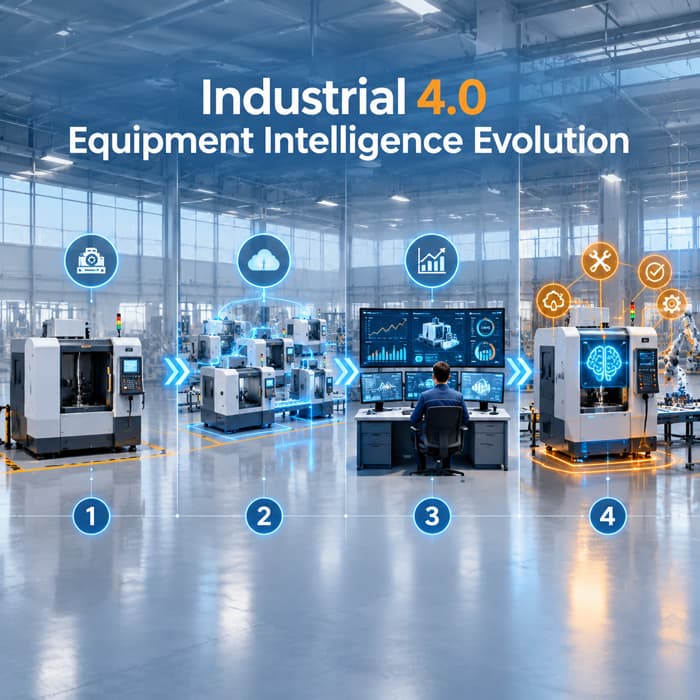 (Image generated by AI: Diagram illustrating the evolution of Industry 4.0 equipment intelligence—from standalone operation, data connectivity, and real-time monitoring to ultimate predictive maintenance and autonomous decision-making.)
1. Deep Integration Between IoT and CNC Rotary Tables
A traditional rotary table is mainly a closed mechanical and servo-driven system. In many cases, machine overload, internal worm gear wear, abnormal vibration, or brake degradation can only be judged by the experience, hearing, and observation of on-site technicians.
With the integration of IoT sensors, an intelligent rotary table can build its own internal monitoring network:
- Thermal Sensing: Real-time monitoring of temperature rises in spindle bearings and motors. This prevents thermal deformation from compromising arc-second level positioning accuracy.
- Vibration and Acoustic Monitoring: Utilizing 3-axis accelerometers to capture abnormal vibration frequencies during the cutting process. This proactively prevents tool chipping or spindle damage caused by heavy roughing operations.
- Torque Feedback: Combining absolute encoders with drive current data allows the system to accurately capture the exact load status during every rotational move and braking sequence.
2. Eliminating Unplanned Downtime: Big Data and Predictive Maintenance
Unplanned machine downtime is the Achilles' heel of mass production lines. By collecting massive amounts of operational data over thousands of running hours, the backend system can establish a comprehensive "health baseline" for the rotary table.
Practical Application of Data Analytics
When big data algorithms detect a slight anomaly—such as a marginal increase in the servo motor's current at a specific indexing angle, or if the hydraulic pressure build-up for the braking system is delayed by just 0.2 seconds compared to the baseline—the system can predict widening worm gear backlash or the aging of hydraulic seals. Shifting from a "fix it when it breaks" (reactive maintenance) approach to a "service it before it fails" (predictive maintenance) model virtually eliminates unpredicted production halts.
3. Cloud Monitoring: Real-Time Protection for Global Factories
For enterprises managing transnational factory networks or multiple highly automated production lines, cloud monitoring is an indispensable management tool. Plant managers and equipment engineers can instantly check the real-time operational status of every rotary table directly from a tablet or smartphone. If the system detects an abnormal machining load (for instance, a programming error that poses an imminent crash risk), the cloud platform pushes an alert to shop-floor personnel within milliseconds. It can even interface directly with the CNC controller to trigger an emergency stop, minimizing hardware damage.
4. Leveraging Big Data Analytics to Maximize Efficiency
The true value of smart manufacturing emerges once equipment accumulates sufficient data. Through comprehensive big data analytics, engineers can identify the most stable machining parameters, pinpoint which load patterns are most likely to cause anomalies, and track exactly when OEE drops occur. These actionable insights enable manufacturers to optimize tool paths, streamline production scheduling, and refine maintenance rhythms, ultimately driving down downtime risks and machining costs.
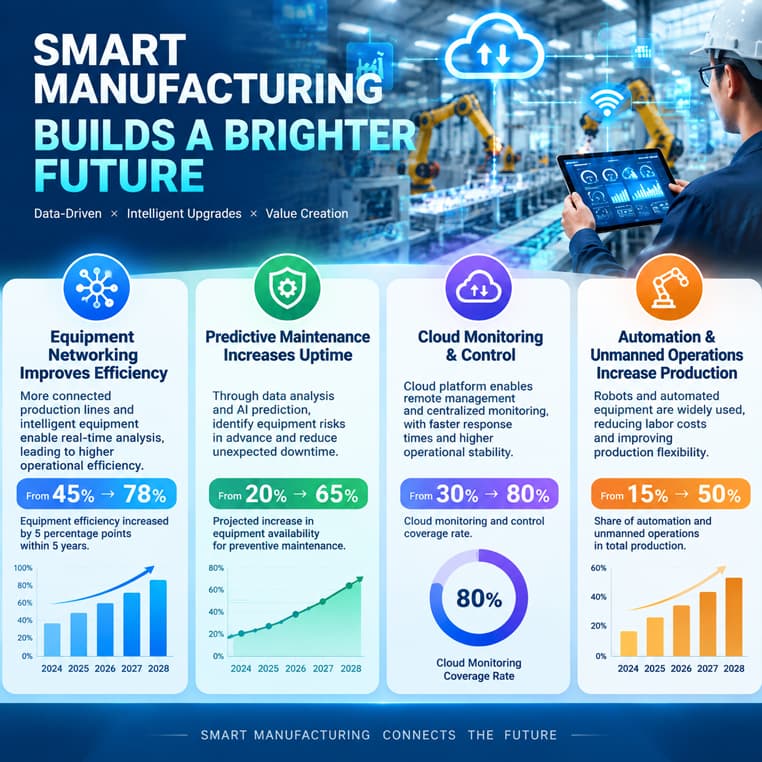
5. Detron’s Direction in Smart Rotary Table Development
As the world's largest professional rotary table manufacturer, Detron Machine Co., LTD. is not only continuously pushing the boundaries of mechanical rigidity and precision but also actively pioneering advancements in smart manufacturing. Our latest high-end, large-scale 5-axis rotary tables (such as the D2TF800H) have been jointly certified under the ISO 14955-1:2017 green energy machine tool standard, significantly reducing carbon footprint and energy consumption during operation. Moving forward, Detron will continue to expand our sensor interface capabilities, ensuring seamless integration with mainstream global CNC controllers (including FANUC, Siemens, and Heidenhain). Our goal is to transform the rotary table into the most intelligent machining joint on your CNC machine.
Transitioning to Industry 4.0 is not merely a slogan—it is about utilizing precise data to tangibly elevate production capacity and yield rates.